


Introduction
Wondering if a doctor can actually diagnose a UTI without you peeing in a cup? In many cases, yes. A telehealth UTI consultation allows a licensed provider to review your symptoms, medical history, and risk factors to determine whether an online UTI diagnosis may be appropriate. This article explains the clinical basis for symptom-based diagnosis, when empiric treatment may be appropriate, and when a urine test or in-person evaluation is needed.
At 24HrDOC, board-certified providers review every consultation individually, and the platform is accredited by the National Committee for Quality Assurance (NCQA). Provider availability varies by state. The goal is to help you get care from the comfort of home while ensuring treatment decisions are based on your symptoms, history, and clinical guidelines.
For healthy, non-pregnant adult women with classic UTI symptoms and no signs of a more serious infection, providers may use a symptom-based approach called empiric diagnosis. This approach evaluates symptoms such as burning during urination, urinary urgency, frequent urination, and pelvic discomfort to determine whether treatment may be appropriate.
Quick Answer:Yes. Telehealth providers can often diagnose uncomplicated UTIs without a urine test using symptom-based clinical screening and determine whether treatment is appropriate.
How Telehealth Diagnoses a UTI: The Symptom-Based Approach
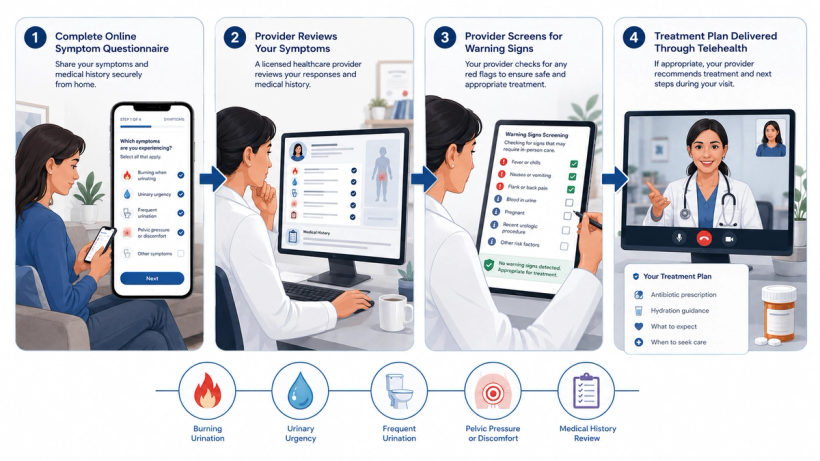
Telehealth providers diagnose many uncomplicated UTIs using a structured symptom review rather than a physical exam or immediate urine test. During your online assessment, the provider evaluates your symptoms against a structured intake checklist and screens for warning signs that may require in-person care.
Empiric treatment means a provider uses your symptoms, health history, and risk factors to make a treatment decision before lab testing is performed. According to Infectious Diseases Society of America (IDSA) guidance, this is a recognized approach for acute uncomplicated cystitis in healthy, non-pregnant women.
Common symptoms providers evaluate include:
- Dysuria (burning during urination)
- Urinary frequency
- Urinary urgency
- Suprapubic pain or pressure
- Hematuria (blood in the urine)
If your symptoms follow a classic uncomplicated pattern and you do not report fever, flank pain, pregnancy, or other high-risk factors, telehealth for UTI care may be appropriate.
According to IDSA guidance, symptom patterns in otherwise healthy adult women can help support an uncomplicated urinary tract infection diagnosis. This is one reason telehealth UTI evaluations can be appropriate for selected patients.
A 2023 study by Daumeyer et al. (PMC9894494) reviewed 51,474 women treated through telehealth for urinary symptoms. Researchers found that 94% of prescriptions were guideline-concordant, and 89.7% of patients who received treatment reported symptom resolution within 7 days. The findings support the real-world effectiveness of symptom-based online UTI diagnosis when patients are appropriately screened.
The study did not directly test whether urine testing can always be omitted. Instead, it provides real-world evidence that telehealth UTI treatment can achieve positive outcomes when providers use appropriate screening and patient selection.
For a broader overview of symptoms, causes, and prevention, see understanding and managing UTIs.
When a Urine Test Is — and Isn't — Required
Not every urinary tract infection diagnosis requires a urine dipstick or culture. According to Infectious Diseases Society of America (IDSA) guidance for acute uncomplicated cystitis, providers can often assess symptoms and medical history and initiate empiric treatment without a urine test.
Telehealth for UTI care may be appropriate for healthy, non-pregnant adult women with a classic symptom pattern and no red flags. In these cases, providers can evaluate symptoms and medical history and determine whether telehealth UTI treatment may be appropriate without in-person testing.
A urine culture or in-person evaluation is usually recommended if you:
- Are pregnant or may be pregnant
- Have recurrent UTIs
- Have fever, flank pain, nausea, or vomiting
- Have a history of antibiotic-resistant organisms
- Recently used a catheter or had a recent hospital stay
- Are immunocompromised
- Are male
- Are a pediatric patient
Recurrent UTIs are generally defined as two or more infections within 6 months or three or more within 12 months. In these situations, providers often need additional testing to identify the underlying cause and guide treatment.
Pregnant women, men, minors, and immunocompromised patients often require laboratory testing or in-person evaluation because their risk factors and treatment needs differ from uncomplicated cases.
To make these decisions safely, providers ask targeted questions about your symptoms and medical history before determining the most appropriate next step.
What Symptoms a Telehealth Provider Asks About
During a telehealth for urinary tract infection visit, your provider asks detailed questions to determine whether your symptoms match an uncomplicated UTI or whether additional evaluation may be needed.
Common symptoms providers evaluate include:
- Dysuria (pain or burning during urination)
- Urinary frequency
- Urinary urgency
- Suprapubic pain or pressure
- Hematuria (blood in the urine)
These symptoms, especially when they occur together, can help support an online UTI diagnosis.
Providers also look for symptoms that may suggest another condition. Vaginal itching, unusual discharge, odor, or irritation may indicate bacterial vaginosis (BV) or an STI rather than a UTI. Your provider may ask additional questions before recommending treatment.
You can also learn more in our guide: UTI vs. STD: know the difference.
Seek emergency care immediately if you have severe flank or back pain, fever ≥101°F, blood in urine with fever, vomiting you cannot control, or signs of sepsis (confusion, rapid heart rate). These may indicate a kidney infection or a life-threatening condition. Call 911 or go to the nearest ER.
Providers also ask about fever, chills, flank or back pain, and nausea or vomiting because these symptoms may suggest a kidney infection and require a higher level of care.
The Clinical Evidence for Empiric UTI Treatment
A 2023 study by Daumeyer et al. (PMC9894494) reviewed 51,474 women treated through telehealth for urinary symptoms. Researchers found that 94% of prescriptions followed clinical guidelines, and 89.7% of patients who received treatment reported symptom resolution within 7 days. The study included both uncomplicated and complicated UTI symptom profiles, providing real-world evidence that symptom-based telehealth UTI treatment can achieve outcomes similar to in-office care when patients are appropriately evaluated.
At the same time, the study did not directly test whether urine dipsticks or urine cultures can always be omitted. Instead, it supports the use of symptom-based screening and empiric treatment when providers determine it is appropriate.
If treatment is appropriate, providers may prescribe first-line antibiotics recommended by Infectious Diseases Society of America (IDSA) guidance for uncomplicated cystitis, including nitrofurantoin and trimethoprim-sulfamethoxazole.
Your provider selects the appropriate antibiotic based on your symptoms, history, local resistance patterns, and allergies, not by patient request. The prescribing decision is the provider's.
If you want to learn more about the prescription process, see get antibiotics for a UTI online.
Responsible prescribing helps reduce antibiotic resistance and supports safer treatment for urinary symptoms. If your symptoms suggest a more complicated infection, your provider may recommend a urine culture or in-person evaluation instead of immediate treatment.
For guidance on treatment and follow-up care, see managing UTI and medicine online.
When Telehealth Is NOT Enough: Red Flags Requiring In-Person Care
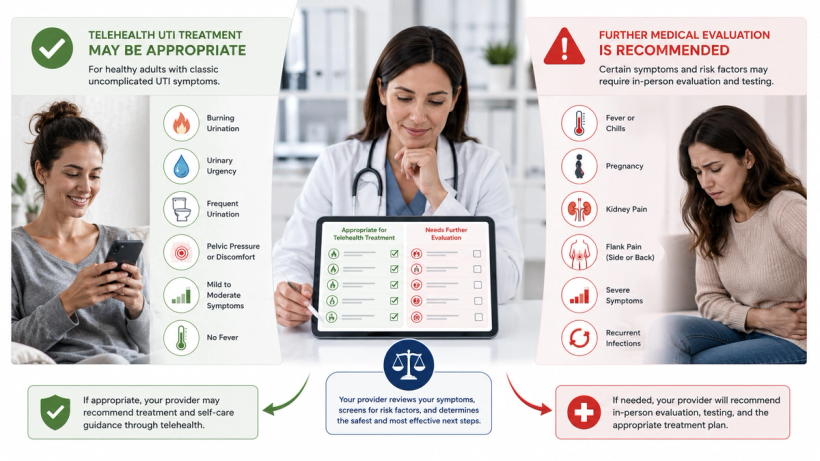
Telehealth works best for uncomplicated bladder infections. Some symptoms and risk factors require in-person evaluation to ensure you receive the right level of care.
Seek urgent care or emergency care if you have:
- Fever of 101°F or higher with UTI symptoms
- Severe flank or back pain
- Nausea or vomiting that prevents you from keeping down medication
- Blood in the urine with fever
These symptoms may suggest a kidney infection and can require in-person evaluation and treatment.
Telehealth UTI care may not be appropriate if you:
- Are pregnant or may be pregnant
- Are male
- Are a child
- Have recurrent UTIs
- Are immunocompromised
Men typically require an in-person evaluation that may include assessment for prostate involvement. Children and pregnant patients generally require in-person care and additional testing.
Recurrent UTIs are generally defined as two or more infections within 6 months or three or more infections within 12 months. These cases often require a urine culture and may require referral to a urology specialist.
Most uncomplicated UTIs begin improving within 48 to 72 hours after starting antibiotics. If your symptoms do not improve or become worse during that time, contact a provider for further evaluation.
Provider availability varies by state.
How 24HrDoc Handles UTI Consultations
24HrDOC offers telehealth for UTI care through a simple three-step process. The intake process screens for pregnancy, male patients, and indicators of a complicated UTI to help determine whether telehealth treatment is appropriate.
- Step 1: Enter Your Symptoms and Medical History
Complete a short assessment about your symptoms and health history. Most visits take about 10 minutes, and appropriate patient screening is built into the process.
- Step 2: Get Reviewed by a Board-Certified Provider
A board-certified provider reviews your information and creates a personalized treatment plan. If additional testing or in-person care is needed, you will receive guidance on the next steps.
- Step 3: Prescription Sent for Pickup
If treatment is appropriate, your prescription is sent electronically to your local pharmacy for pickup, often within 45 minutes. Some pharmacy programs may also offer home delivery.
24HrDOC is an NCQA-accredited telehealth platform with board-certified providers available 24/7. The platform has delivered trusted healthcare for more than 20 years and has earned more than 10,000 five-star reviews.
Provider availability varies by state.
For more information about the process, see how does online UTI treatment work.
Ready to get started? Explore online UTI treatment and talk to a doctor now. Start your visit from $39.99.
Cost: Telehealth UTI Visit vs. Urgent Care
For many patients, the decision is about both time and cost. Instead of sitting in a waiting room or taking time off work, telehealth for a UTI allows you to connect with a licensed provider from home.
At 24HrDOC, visits start at $39.99. There are no insurance requirements, no copays, and no hidden fees. Prescription costs are separate and depend on your pharmacy and medication.
In-person urgent care visits often range from $60 to $250 before medication costs. Emergency room visits can be significantly more expensive. For patients with uncomplicated urinary symptoms, telehealth may provide a faster and more convenient way to get evaluated.
Care Option
Typical Visit Cost
Notes
24HrDOC Telehealth Visit
Starting at $39.99
No insurance required
Urgent Care Visit
~$60–$250
Medication cost separate
Emergency Room Visit
Often significantly higher
May include imaging, labs, IV treatment
No waiting room. No time off work. No $200 urgent care bill. Just transparent pricing and access to care from the comfort of home.

Frequently Asked Questions
Can a telehealth doctor diagnose a UTI without a urine test?
Yes. In many cases, a telehealth provider can diagnose an uncomplicated UTI without a urine test. Providers use symptom-based screening, medical history, and red-flag questions to determine whether telehealth UTI treatment is appropriate.
A 2023 study of 51,474 women treated through telehealth found that 89.7% of patients who received treatment reported symptom improvement within 7 days. A urine test is not always required for healthy, non-pregnant adult women with classic UTI symptoms and no signs of a more serious infection.
For more information about eligibility and provider review, see can you get UTI antibiotics online safely.
What symptoms does a telehealth provider use to diagnose a UTI?
A telehealth provider typically asks about burning during urination, urinary urgency, frequent urination, suprapubic pain or pressure, and blood in the urine. These symptoms may support an online UTI diagnosis when they follow a classic uncomplicated pattern.
Providers also screen for fever, flank pain, chills, nausea, vomiting, vaginal discharge, itching, odor, or other symptoms that may suggest a kidney infection, STI, or another condition requiring in-person evaluation.
When is a urine culture required for a UTI diagnosis?
A urine culture is often recommended for recurrent UTIs, pregnancy, fever, flank pain, recent hospitalization, catheter use, or a history of antibiotic-resistant infections.
Providers may also recommend testing if symptoms do not improve within 48 to 72 hours after starting treatment. Recurrent UTIs are generally defined as two or more infections within 6 months or three or more infections within 12 months.
Can telehealth prescribe antibiotics for a UTI?
Yes. Licensed providers can prescribe antibiotics through telehealth when clinically appropriate and permitted by state regulations. Common first-line treatments for uncomplicated UTIs may include nitrofurantoin or trimethoprim-sulfamethoxazole, depending on your symptoms, allergies, and medical history.
At 24HrDOC, prescriptions are sent electronically to your preferred pharmacy after provider review. Provider availability varies by state.
Is telehealth UTI treatment safe for recurrent UTIs?
Telehealth can help evaluate recurrent symptoms, but recurrent UTIs often require additional testing or in-person follow-up. A provider may recommend a urine culture or referral for further evaluation to identify the underlying cause.
When should I go to urgent care or the ER instead of using telehealth for a UTI?
Seek urgent care or emergency care if you have a fever of 101°F or higher, severe flank or back pain, uncontrollable vomiting, blood in the urine with fever, confusion, or other signs of a serious infection.
Pregnant patients, men, children, and people with recurrent UTIs often require additional evaluation beyond telehealth. If symptoms do not improve within 48 to 72 hours after starting antibiotics, follow up with a provider promptly.
Get UTI Care Online Without the Waiting Room
For many healthy, non-pregnant adults with classic symptoms, online UTI treatment can be a safe and convenient way to get care without leaving home. The key is proper screening — knowing when symptom-based treatment is appropriate and when an in-person exam or urine testing is the safer choice.
24HrDOC connects patients across the United States with licensed providers who review your symptoms, medical history, and risk factors before recommending treatment. If appropriate, a provider can create a personalized treatment plan and send a prescription to your preferred pharmacy. Provider availability varies by state.
Talk to a doctor now — start your visit from $39.99.
Educational Disclaimer: This article is for educational purposes only and does not replace consultation with a licensed healthcare provider.
Pharmacy Disclaimer: 24HrDOC is not a pharmacy. We do not carry or ship medicines. Online Doctor Prescriptions are sent electronically to your pharmacy after an online medical
Share this article