


Introduction
Burning when you pee. Frequent trips to the bathroom. Pelvic pressure. These symptoms can be frustrating and confusing because they may point to a urinary tract infection (UTI) or a sexually transmitted infection (STI).
If you're searching for UTI vs STI or STI vs UTI, you're not alone. These are two different conditions that can sometimes cause similar symptoms, especially in the early stages. While symptoms may provide clues, testing is the only reliable way to confirm what's causing them.
The good news is that both UTIs and many STIs are common, treatable conditions. Getting tested and seeking care is a responsible step toward protecting your health.
This guide explains how to tell the difference between a UTI and an STI, compares common symptoms, and outlines the next steps for each situation. If your symptoms fit a classic UTI pattern, online treatment may be an option. If your symptoms suggest an STI, testing first is usually the safest path before treatment.
At 24HrDOC, every visit is reviewed by a board-certified provider. Through our NCQA-accredited telehealth platform, you can access confidential care from the comfort of home, 24/7.

UTI vs STI: The Short Answer
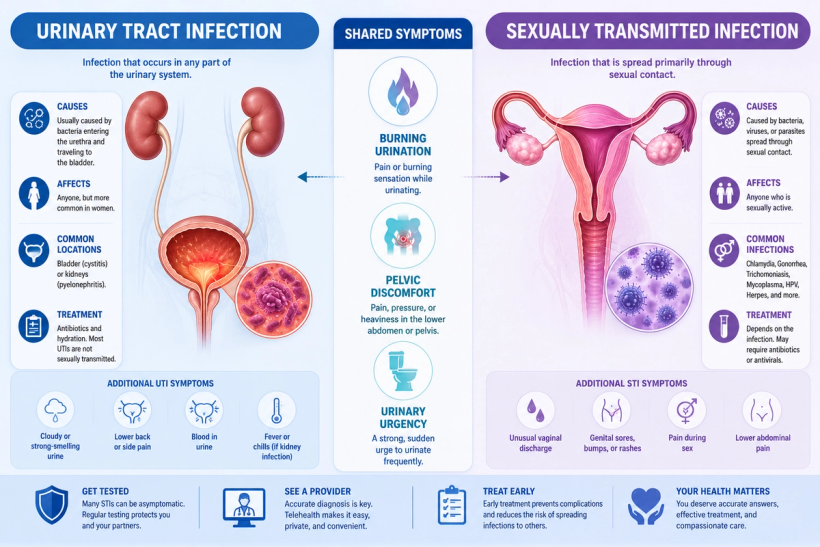
When comparing UTI vs STI, the key difference is that a urinary tract infection (UTI) is a bacterial infection of the urinary tract and is not sexually transmitted, while an STI is transmitted through sexual contact and may cause urinary symptoms. Although symptoms can overlap, they are different conditions.
If you're wondering, "Is a UTI an STI?", the answer is no. Research by Sheele et al. (2024; PMC11112662) found that concurrent bacterial UTI and STI infections are clinically unlikely, and urinalysis alone cannot rule out an STI.
Here’s the simplest breakdown:
- UTI: A bacterial infection of the urinary tract; it is not sexually transmitted.
- STI: An infection transmitted through sexual contact that may cause urinary symptoms.
- Both: May cause burning during urination, pelvic discomfort, and other urinary symptoms.
- Testing matters: Symptoms may suggest a condition, but they cannot reliably confirm one.
If you're comparing STI vs UTI symptoms, the safest next step is appropriate testing and provider review.
Is a UTI an STI?
No — a UTI is not an STI.
Most UTIs occur when bacteria, most commonly E. coli, enter the urethra and cause an infection in the urinary tract. An STI is transmitted through sexual contact. While UTI and STI symptoms can overlap, they are separate conditions with different causes.
Sexual activity can increase the risk of a UTI. Some women develop post-coital UTIs when bacteria are introduced into the urethral area during sex. However, that does not mean the infection was sexually transmitted.
You may also notice healthcare providers use the term "STI" instead of "STD." The CDC prefers sexually transmitted infection (STI) because a person can carry and transmit an infection even without symptoms.
Understanding the difference between a UTI and an STI can help you choose the right next step for testing and treatment.
Symptom Comparison: UTI vs STI Side by Side
One reason STI vs UTI symptoms can be confusing is that both conditions may cause burning during urination and pelvic discomfort. While certain symptoms may suggest one condition more than the other, symptoms alone cannot confirm whether you're dealing with a UTI or an STI.
UTI Symptoms
STI Symptoms
Shared Symptoms
Burning during urination
Abnormal discharge
Burning during urination
Urinary urgency and frequency
Genital sores, rash, or itching
Pelvic discomfort
Cloudy or strong-smelling urine
Pain during sex
Lower abdominal or pelvic pain
Blood in the urine (hematuria)
Bleeding between periods
Urinary discomfort
Lower abdominal or bladder pressure
Pelvic pain (PID risk)
Symptoms such as urinary urgency, cloudy urine, strong-smelling urine, or blood in the urine may indicate a UTI. Abnormal discharge, genital irritation, sores, pain during sex, or bleeding between periods may suggest an STI.
UTI symptoms vs STI symptoms can overlap because both conditions may cause inflammation of the urethra, leading to burning during urination and pelvic discomfort.
According to the CDC and Mayo Clinic, symptoms can provide clues but cannot reliably distinguish a UTI from an STI. If you're trying to understand how to tell the difference between a UTI and STI, testing remains the most reliable way to confirm the cause of your symptoms.
STIs That Feel Like a UTI
Some STIs can cause symptoms similar to a urinary tract infection. When comparing STI vs UTI symptoms, urinary burning, pelvic discomfort, and changes in urination may occur with either condition.
STIs are common, treatable infections, and getting tested is a responsible health choice. According to the CDC, millions of STI cases occur in the United States each year, so symptoms should be evaluated rather than ignored.
Chlamydia
Chlamydia often causes no symptoms, but when symptoms occur, they may include:
- Burning during urination
- Mild pelvic pain
- Subtle or unusual discharge
Because symptoms can be mild, chlamydia may sometimes be mistaken for a UTI.
Learn more about Chlamydia treatment online.
Gonorrhea
Possible symptoms include:
- Burning during urination
- Increased vaginal discharge
- Pelvic pain
If left untreated, gonorrhea may increase the risk of pelvic inflammatory disease (PID).
Learn more about Gonorrhea treatment online.
Trichomoniasis
Symptoms may include:
- Burning during urination
- Vaginal irritation
- Changes in odor or discharge
Some people have mild symptoms or no symptoms at all.
Learn more about Trichomoniasis treatment online.
Mycoplasma genitalium
Mycoplasma genitalium may cause urethritis-like symptoms, including urinary burning and pelvic discomfort. Diagnosis typically requires specialized testing.
Research published by Sheele et al. (PMC11112662, 2024) found that positive testing for gonorrhea, chlamydia, and trichomoniasis showed no significant association with bacterial UTI. In other words, these infections are usually distinct conditions, even when UTI vs STI symptoms appear similar.
When You Need Testing to Know for Sure
If you're trying to understand how to tell the difference between a UTI and STI, symptoms alone cannot confirm the cause. While certain symptoms may suggest one condition over another, testing is the only reliable way to distinguish a UTI from an STI.
UTI Testing
Testing for a UTI typically involves:
- Urinalysis (dipstick testing)
- Urine culture
A urinalysis looks for signs of infection, including bacteria, white blood cells, and nitrites. According to Sheele et al. (PMC11112662, 2024), nitrite-positive urine was strongly associated with bacterial UTI (OR 15.7).
A urine culture may help identify the bacteria causing the infection and guide treatment decisions.
STI Testing
Testing for an STI commonly involves:
- Nucleic acid amplification testing (NAAT)
- Vaginal swabs
- Urine samples
According to CDC recommendations, NAAT is the preferred testing method for chlamydia, gonorrhea, and trichomoniasis because of its high sensitivity and specificity.
A key finding from the 2024 PMC study is that urinalysis alone cannot rule out an STI. If you've recently had unprotected sex and are experiencing urinary symptoms, a provider may recommend testing for both a UTI and an STI at the same time.
Learn more about Lab testing to discuss the most appropriate testing option for your symptoms.
Quick Decision Guide: UTI Route vs STI Route
While testing provides the clearest answer, certain symptom patterns may help guide your next step.
Possible UTI Route
Symptoms may include:
- Burning during urination
- Frequent urination
- Bladder pressure
- No unusual discharge
- No genital sores or rash
- No recent STI exposure concerns
Next step: Consider urinalysis and provider evaluation. If your symptoms fit a typical uncomplicated UTI pattern, Online UTI treatment may be an appropriate next step.
Possible STI Route
Symptoms may include:
- Unusual discharge
- Pain during sex
- Genital sores or irritation
- Bleeding between periods
- Recent unprotected sex
- Symptoms that did not improve after antibiotics
Next step: Testing is usually recommended before treatment. Learn more about confidential Lab testing options to help determine the most appropriate next step.
Urgent In-Person Care
Seek immediate medical care if you experience:
- Fever above 101°F
- Flank or back pain
- Vomiting
- Severe pelvic pain
- Heavy bleeding
These symptoms may indicate a more serious condition that requires prompt in-person evaluation.
What to Do If It’s a UTI
If your symptoms fit a classic uncomplicated UTI profile, a provider may recommend urinalysis and treatment. Common signs may include:
- Burning during urination
- Frequent urination
- Urinary urgency
- Bladder pressure or mild lower abdominal discomfort
- No unusual discharge
- No genital sores or rash
- No recent unprotected sex concerns
According to ACOG and AAFP, uncomplicated UTIs can often be evaluated and treated based on symptoms and provider assessment. Testing may still be recommended when symptoms are unclear.
If your symptoms are more consistent with a UTI than an STI, Online UTI treatment may be an option. With 24HrDOC, you can get care from the comfort of home. A board-certified provider reviews your symptoms and medical history to determine whether treatment is appropriate. If prescribed, your prescription can be sent electronically to your preferred pharmacy for pickup, with many patients able to pick up medication within about 45 minutes. Visits start at $39.99.
Your provider will determine the appropriate antibiotic based on your symptoms, medical history, and allergies. Do not self-prescribe antibiotics or request a specific medication. Responsible antibiotic use supports safe, effective treatment.
Talk to a provider now — start your UTI visit from $39.99.
Fever, chills, back or flank pain, nausea, or vomiting may indicate a more serious infection, including a possible kidney infection. If these symptoms are present, seek in-person medical care or emergency evaluation.
What to Do If It’s (or Might Be) an STI
If your symptoms suggest an STI, testing should come first. Signs that may point toward an STI rather than a UTI include:
- Unusual discharge
- Genital sores, rash, or irritation
- Pain during sex
- Pelvic pain
- Recent unprotected sex
- Symptoms that did not improve after antibiotic treatment
When comparing UTI vs STI symptoms, testing is often the most important next step. The CDC recommends NAAT (nucleic acid amplification testing) for chlamydia, gonorrhea, and trichomoniasis because of its high sensitivity and specificity. If you're unsure whether your symptoms are related to a UTI or STI, Lab testing can help identify the cause and guide treatment.
Treatment depends on the infection identified through testing. Learn more about:
- Chlamydia treatment online
- Gonorrhea treatment online
- Trichomoniasis treatment online
- 3-STD combo treatment if you're unsure which STI may be causing your symptoms
STIs are common, treatable infections, and getting tested is a responsible step for your health. At 24HrDOC, visits are fully confidential and reviewed by board-certified providers through our NCQA-accredited platform.
If testing confirms an STI, the CDC recommends informing recent sexual partners so they can be tested and treated if needed. Partner notification is a caring step that can help reduce reinfection and protect long-term health.
Speak with a board-certified provider — confidential STI treatment from $39.99.
When to See a Doctor In Person Urgently
Most UTIs and many STIs can be treated through outpatient or telehealth care. However, some symptoms require immediate in-person evaluation.
- Possible Kidney Infection: Fever over 101°F, chills, flank pain, or nausea and vomitingmay indicate a kidney infection and require urgent in-person or emergency care.
- Possible Pelvic Inflammatory Disease (PID): Severe lower abdominal or pelvic pain with fever in the setting of a possible STI requires immediate in-person evaluation.
- Pregnancy: According to ACOG guidance, UTIs and STIs during pregnancy require specialized evaluation and management. If you are pregnant and develop symptoms of a UTI or STI, seek prompt in-person care from your OB provider.
- Severe Symptoms: Heavy vaginal bleeding, severe genital pain, signs of a systemic infection, or other rapidly worsening symptoms require immediate medical attention. Call 911 or go to the ER if symptoms are severe.
Emergency disclaimer: Online medical consultations aren't a substitute for emergency care. Call 911 or go to the nearest ER for severe pain, fever with chills, or any life-threatening symptom.

Frequently Asked Questions
Is a UTI the Same as an STI?
No. A urinary tract infection (UTI) and a sexually transmitted infection (STI) are different conditions, even though they can cause similar symptoms.
A UTI is usually caused by bacteria entering the urinary tract, while an STI is transmitted through sexual contact.
This is why the UTI vs STI question is so common. Burning urination, pelvic pressure, and urinary discomfort may occur with either condition, making testing important when symptoms overlap.
Can an STI Feel Like a UTI?
Yes. Some STIs can cause symptoms similar to a UTI, especially early in an infection.
Chlamydia, gonorrhea, trichomoniasis, and Mycoplasma genitalium may cause burning urination, pelvic discomfort, or urinary urgency.
According to Sheele et al. (2024), STI and UTI symptoms can overlap. Testing is the most reliable way to determine the cause of your symptoms.
How Do I Know if It's a UTI or an STI Without Getting Tested?
You usually cannot know for sure without testing.
Frequent urination, bladder pressure, and cloudy urine may suggest a UTI, while abnormal discharge, genital sores, or pain during sex may suggest an STI.
However, symptoms alone cannot confirm whether you have a UTI or STI. A provider may recommend urinalysis for a UTI and NAAT testing for an STI.
Can I Get Online Treatment for a UTI Without a Urine Test?
In some cases, yes.
Many uncomplicated UTIs can be evaluated through telehealth based on your symptoms, medical history, and risk factors. A licensed provider reviews your assessment and determines whether treatment is appropriate.
At 24HrDOC:
- Visits start at $39.99
- Prescriptions are sent electronically to your preferred pharmacy if medically appropriate
- No insurance required
Some symptoms may still require lab testing or in-person evaluation.
What STIs Can Be Mistaken for a UTI?
Several STIs may be mistaken for a UTI because they can cause urinary symptoms, including:
- Chlamydia
- Gonorrhea
- Trichomoniasis
- Mycoplasma genitalium
These infections may cause painful urination, pelvic discomfort, or urinary irritation that can resemble a bladder infection.
Can I Have a UTI and an STI at the Same Time?
Yes, but it appears to be clinically uncommon.
A 2024 study by Sheele et al. found that bacterial UTIs were not strongly associated with positive STI testing for chlamydia, gonorrhea, or trichomoniasis.
However, if symptoms overlap or STI risk factors are present, a provider may recommend testing for both conditions at the same time.
Conclusion
When it comes to UTI vs STI, similar symptoms can point to different conditions. Burning urination, pelvic pressure, urinary urgency, or discharge may suggest a UTI, an STI, or another condition that requires evaluation.
The good news is that both UTIs and many STIs are common and treatable. Testing is often the best way to get answers and determine the next step.
If you're unsure what your symptoms may mean, 24HrDOC offers confidential care from board-certified providers through its NCQA-accredited platform. Get care from the comfort of home, with visits starting at $39.99.
Educational Disclaimer:
This article is for educational purposes only and does not replace consultation with a licensed healthcare provider.
24HrDOC is not a pharmacy. We do not carry or ship medications. Online doctor prescriptions are sent electronically to your pharmacy after an online medical consultation.
Similar to a doctor's office, our consultation fee does not include the cost of your medication.
Share this article